
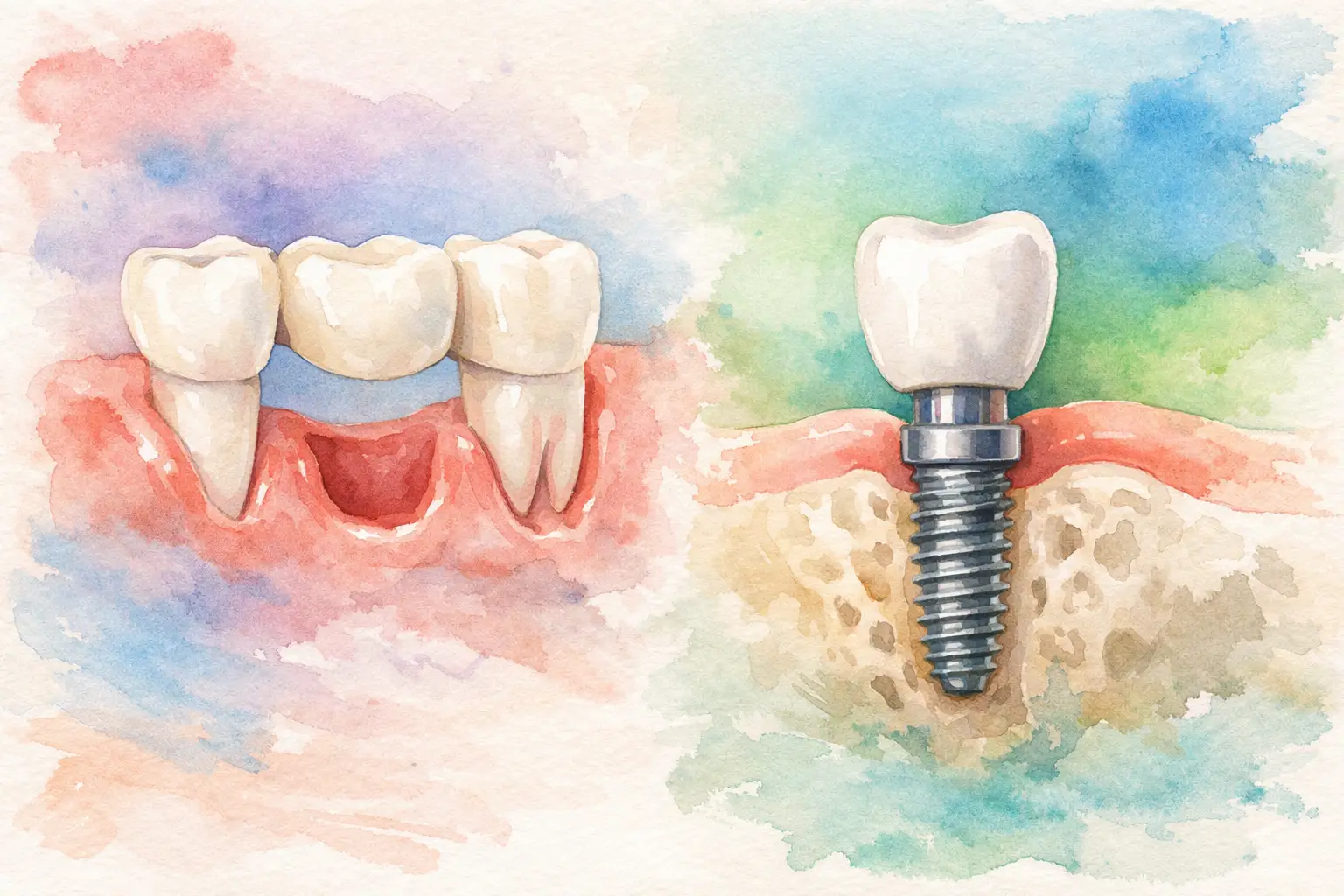
A missing tooth can change more than a smile. You may start favouring one side when chewing, notice food collecting in the space, or feel less comfortable speaking and laughing. When considering a dental bridge versus implant replacement, the right choice is rarely about choosing the most advanced option on paper. It is about finding a solution that fits your oral health, timeline, budget, and long-term goals.
Both treatments can restore function and appearance very effectively. The key difference is how they replace the tooth and what they ask of the surrounding teeth and jawbone.
Dental bridge versus implant replacement: the core difference
A dental bridge fills a gap by attaching a replacement tooth, called a pontic, to the teeth beside it. In a traditional bridge, the neighbouring teeth are shaped to support crowns, and the bridge is cemented in place as one connected restoration. A bridge can also be supported by implants in some situations, particularly when several teeth are missing.
A single dental implant replaces the tooth root as well as the visible tooth. A small titanium post is placed in the jawbone, where it gradually bonds with the bone. Once healing is complete, a custom crown is attached to the implant. Because it stands independently, an implant does not need support from the teeth next to the gap.
This difference affects treatment time, cost, maintenance, and the long-term health of the area. Neither option is automatically right for everyone.
When a dental bridge can be the practical choice
A bridge is often a sensible option when a patient wants a fixed replacement without surgery or needs to restore the space within a shorter timeframe. Once the supporting teeth and gums are healthy enough, bridge treatment can usually be completed in a matter of weeks rather than several months.
It can also make clinical sense when the teeth beside the missing tooth already need crowns because of large fillings, fractures, or extensive decay. In that situation, preparing those teeth for a bridge may be part of an efficient overall restorative plan rather than an unnecessary compromise.
A bridge may be recommended when medical conditions, healing concerns, or certain medications make implant surgery less suitable. Patients with significant dental anxiety may also initially prefer a less surgical approach, although comfort options, including sedation dentistry, can make implant treatment manageable for many people.
The trade-off is that a traditional bridge relies on adjacent teeth. Even healthy neighbouring teeth generally need to be reduced to hold the crowns. Bridges also do not stimulate the bone beneath the missing tooth. Over time, some bone shrinkage can occur in that area, which may affect the gumline and fit of the restoration.
With attentive home care and regular dental visits, a well-made bridge can last many years. Cleaning is different from cleaning a natural tooth, however. You will need to clean beneath the replacement tooth using floss threaders, interdental brushes, or a water flosser as recommended by your dental team.
When an implant may offer greater long-term value
An implant is often preferred for a single missing tooth when there is enough healthy bone and the patient is comfortable with a surgical treatment process. It preserves the neighbouring teeth because they do not need to be shaped for crowns. It also provides stimulation to the jawbone, which helps limit the bone loss that naturally follows tooth loss.
For many patients, the independent feel of an implant is a major benefit. Once the final crown is in place, it is designed to look and function much like a natural tooth. You can brush and floss around it normally, although implants still require careful daily cleaning and professional monitoring of the surrounding gums.
The main consideration is time. Implant treatment often involves a healing period after placement, commonly a few months, before the final crown is attached. If a tooth was removed recently, timing depends on the condition of the socket, infection history, gum health, and available bone. Some cases are appropriate for immediate implant placement, while others benefit from healing first.
Bone grafting may be needed if the jawbone has thinned or if the tooth has been missing for a long time. This can add healing time and cost, but it may create the foundation needed for a stable, lasting result. A digital assessment and detailed examination help determine whether this applies to you.
Cost is real, but it is not the only number to compare
Upfront cost is often lower for a traditional bridge than for a single implant and crown. That difference matters, especially when a tooth needs replacement unexpectedly. Insurance coverage varies widely by plan, and coverage for bridges and implants is not always the same. Eligible patients may also wish to ask about Canadian Dental Care Plan support and direct insurance billing.
Still, it is useful to compare the full treatment picture, not simply the first estimate. A bridge may need replacement after years of use, and the supporting teeth may require future care. An implant has higher initial costs and may require grafting or other preparatory treatment, yet it avoids placing crowns on adjacent healthy teeth.
Durability depends on several factors: the quality of the restoration, bite forces, gum health, regular preventive care, smoking or vaping, clenching or grinding, and daily hygiene. A night guard may be advised for either treatment if grinding is a concern.
Your dentist should provide a clear treatment plan that explains what is included, what may be required before treatment, and the expected maintenance. That makes it easier to make a decision based on value, not pressure.
Your gums and jawbone can change the recommendation
An implant needs healthy gums and sufficient jawbone support. Active gum disease should be treated and stabilized before implant placement, since inflammation around an implant can compromise its long-term success. Diabetes that is not well controlled, heavy tobacco use, and certain medical treatments may also affect healing. These factors do not always rule out implants, but they require careful planning.
A bridge also depends on healthy gums and strong neighbouring teeth. If either supporting tooth has a poor prognosis, using it as an anchor may not be wise. In some cases, replacing multiple missing teeth with implant-supported restorations protects the remaining natural teeth more effectively than a long bridge.
The location of the missing tooth matters as well. A front-tooth replacement has high aesthetic demands, including careful attention to gum shape and colour matching. A back tooth experiences heavier chewing forces. Digital imaging, bite analysis, and smile-focused planning help tailor the restoration to its position and your natural dentition.
What does treatment feel like?
For a bridge, the supporting teeth are prepared under local freezing, impressions or digital scans are taken, and a temporary bridge may be placed while the final restoration is made. Some sensitivity after preparation is possible. At the final appointment, the bridge is checked for fit, appearance, and bite before being cemented.
For an implant, local freezing is used for surgery, and sedation may be available for appropriate patients who feel anxious. Mild swelling, tenderness, or bruising can occur afterward, but many people manage recovery with rest, soft foods for a short period, and recommended medication. Your care team will give you specific instructions and monitor healing before the final crown is placed.
Comfort should be part of the decision, not an afterthought. If dental visits have been difficult in the past, say so early. A calm, staged approach and appropriate sedation options can change the experience significantly.
Questions that lead to a better decision
During a consultation, ask whether the teeth beside the space are healthy, whether your bone is adequate for an implant, and what each option means for your gums over time. It is also reasonable to ask about expected treatment stages, healing time, maintenance, insurance support, and the likely lifespan of each restoration in your particular case.
At ORIS Dental Clinics, comprehensive assessment can bring restorative, gum, surgical, and aesthetic considerations into one coordinated plan. That is especially helpful when tooth replacement involves more than simply filling a gap.
A missing tooth does not need to force a rushed decision. Whether a bridge gives you the most practical path forward or an implant offers the stronger long-term fit, the best next step is a thorough examination and an honest conversation about what will protect your comfort, confidence, and oral health for years ahead.